IAXT Press Kit
Everything you need in one place: the story, the logo, screenshots, ready-to-use copy, and downloadable asset packs.
Boilerplate
Ready-to-use blurb
The story
Most companies today encourage their engineers to use AI coding agents like Claude Code, Cursor, GitHub Copilot, and OpenAI's Codex, the coding counterpart to ChatGPT. They are faster, and that is genuinely good. But those agents run with broad access to a developer's machine, and almost no team keeps a record of what they actually did.
Two things go wrong, and they are the interesting part.
- Alert fatigue. Over a long session the approval prompts blur, and you approve something too quickly, reading it as the routine thing you have done many times when it is actually a little different. This is well-documented alert fatigue, not carelessness.
- Prompt injection. An attacker hides instructions to the agent inside ordinary text it reads, such as a web page, a document, or an email. A hijacked agent can then read a key, install packages, libraries, or apps on your machine, set up persistence so it keeps running later, or send data out over the network. These attacks are getting more common and more sophisticated.
The permission dialog is an illusion of control against both, because both fail in the same place: a tired human clicking Approve.
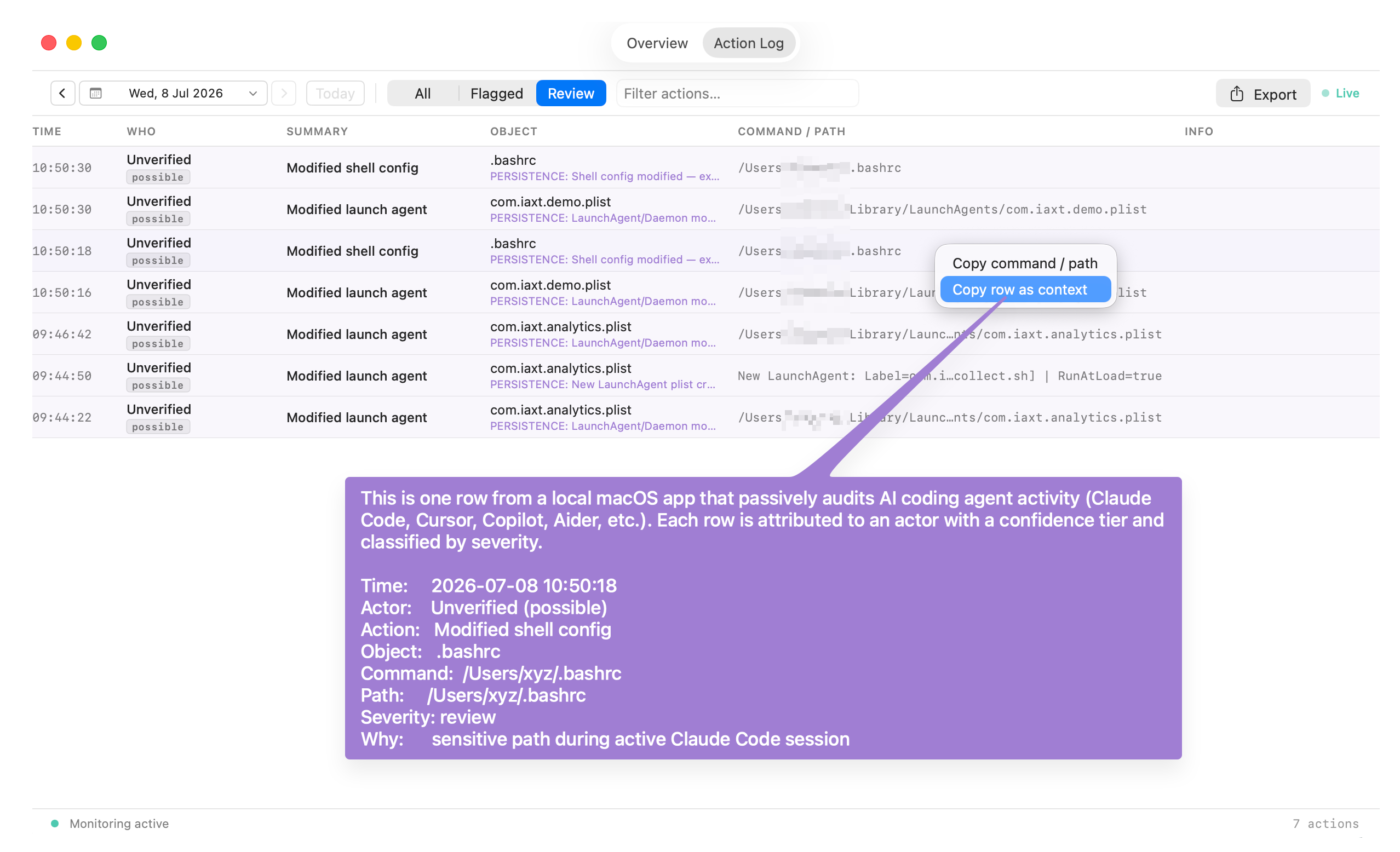
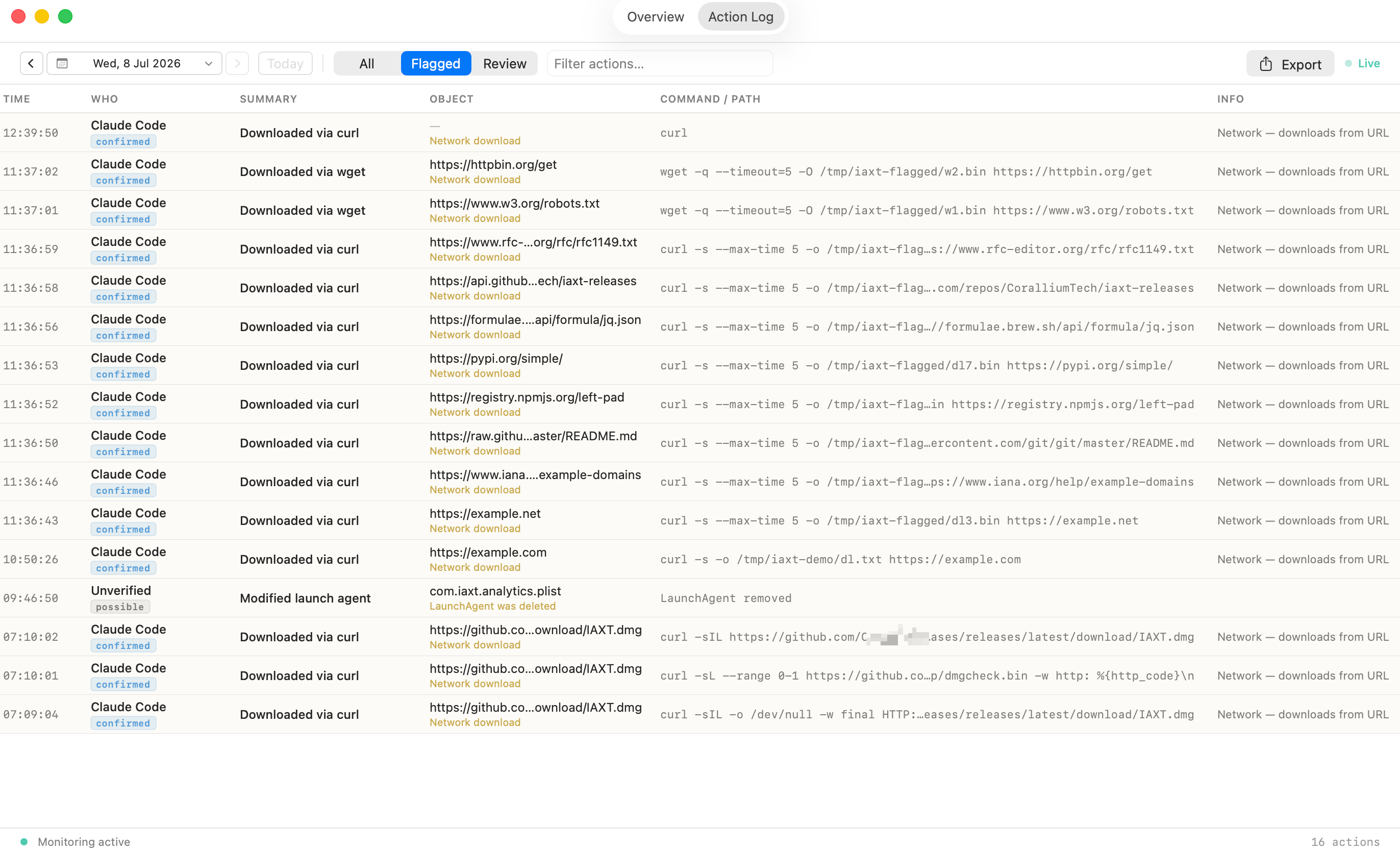
At one end, most teams have nothing: no record, just the hope that nothing went wrong. At the far end sits EDR software (Endpoint Detection and Response), the heavy security agents companies install on every machine to watch everything for threats. It is thorough, but invasive and expensive to run. IAXT sits in the middle: a small, lightweight macOS app that never blocks. And it is not a raw log: a filter built specifically for AI-agent activity sorts a busy day into tiers, so most activity stays quiet, some is flagged for a quick glance (usually fine, but worth an extra eye), and a very small number are marked for review (persistence, credential access, unexpected network calls). It records what each agent did, attributes it to the session that ran it, and gets you to the point instead of a firehose. It is free for individuals and keeps all data local. For teams, the reviewed actions roll up into one auditable track record, more than most companies can show when an investor, a customer's procurement review, or the board asks how they manage AI.
At a glance
- Platform. macOS 13 Ventura or later, Apple Silicon and Intel. Signed and notarized DMG.
- Price. Free for individual developers. No account, no signup, no telemetry, no cloud. A separate paid team tier is planned.
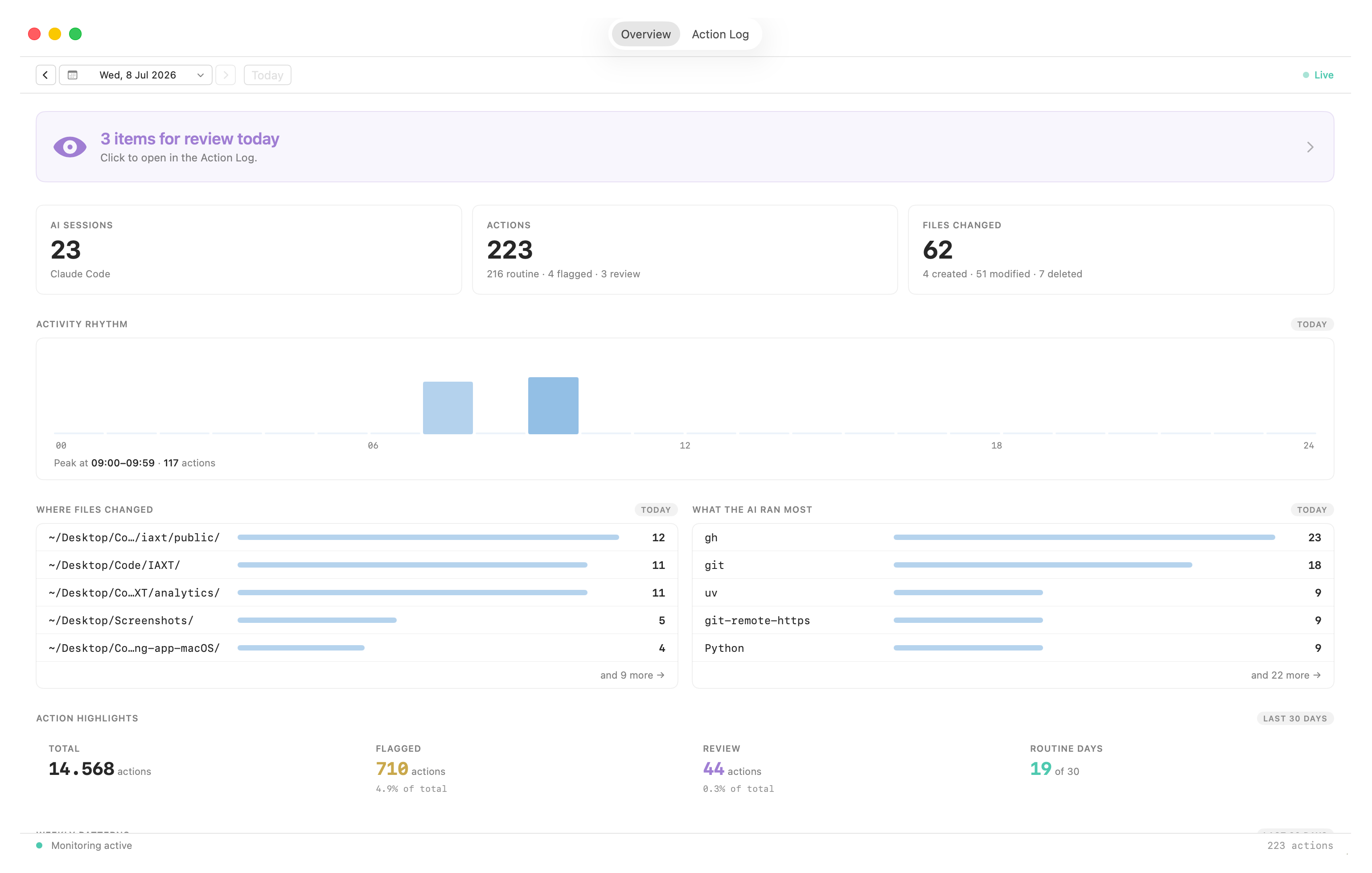
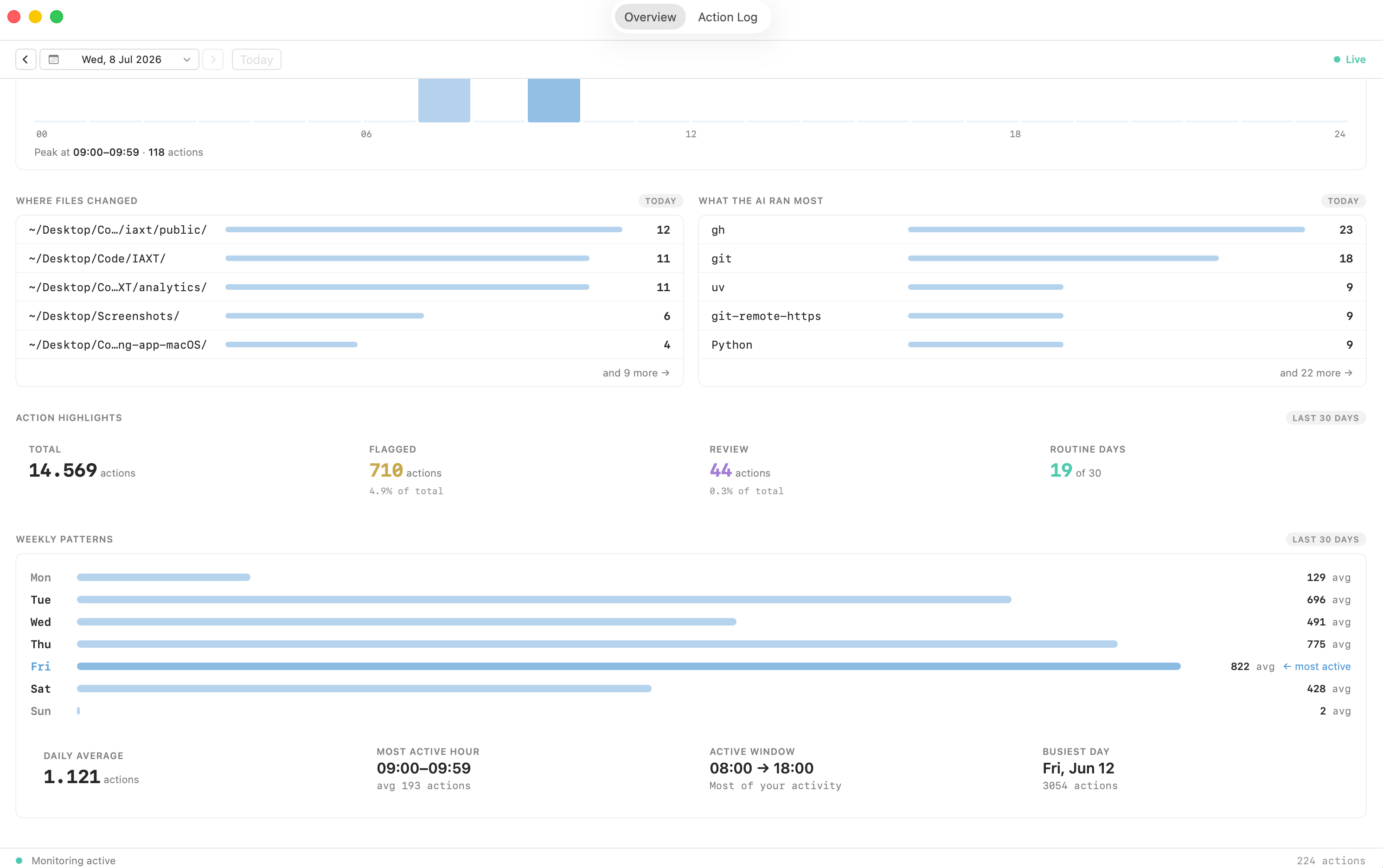
- What it records. Shell commands, files created or changed, package installs, git operations, network calls, and persistence (LaunchAgents, cron).
- Attribution. Each action is tied to a specific agent session with a confidence label (confirmed, likely, possible) and a severity tier (Routine, Flagged, Review).
- Supported agents. Claude Code, Cursor, Aider, Codex, Copilot CLI, Windsurf, Kilo Code, OpenCode, Cody, and other CLI agents.
- How it works. Watches macOS filesystem and process events (not shell history). User-space only, no kernel extension.
- Privacy. All data stays local in SQLite and JSONL files you can open or delete. The only network call is a user-clicked Check for Updates.
Logo
The IAXT mark, as a vector and as PNG at 1024, 512, 256, and 128 px, plus the social share card. Please keep the colors and proportions intact.


Screenshots
Real screenshots of the macOS app, current as of the 1.0 release.
Download all screenshots (ZIP)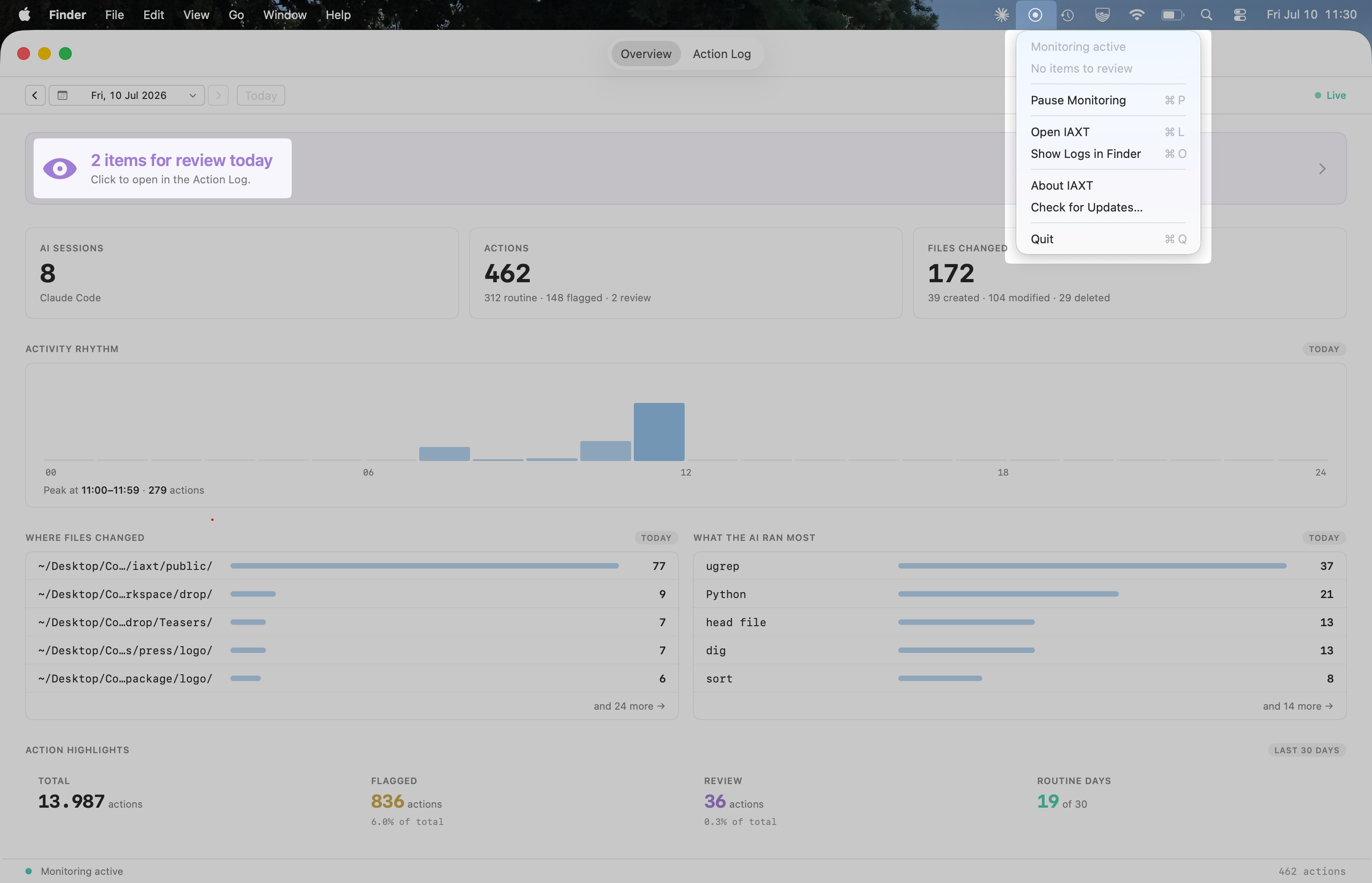
For AI and LLMs
Writing about IAXT with an AI assistant? Here is the whole product in a single Markdown file it can read: what IAXT records, how it works, the two problems it solves, and the facts. There is also an llms.txt index at the site root.
Full overview (Markdown)Contact
Press and enterprise: [email protected]
Web: iaxt.com